
First Day of Daycare Tips: How to Make Drop Off Easier for Everyone
Nobody warns you about the parking lot moment. You buckle your child in, drive to the center, and somewhere between the car and the front door your chest gets tight. Will they cry? Will you? If a September start is coming up for your family, these first day of daycare tips will help you walk through that door with a plan instead of a knot in your stomach. And here is the honest truth up front. The first day is rarely as hard as the days you spend dreading it.
Teachers who have welcomed hundreds of new children will tell you the same thing. Almost every child settles. Almost every parent survives. The difference between a rough transition and a smooth one usually comes down to preparation, routine, and how the goodbye itself is handled.
Why the First Day Feels So Big, For You Too
Let me say something that does not get said enough. Your feelings about this day are just as real as your child’s. Handing your baby or toddler to another caregiver, even a wonderful one, goes against every protective instinct you have. That lump in your throat is not weakness. It is love with nowhere to go for eight hours.
Children, meanwhile, are reading you constantly. Toddlers especially are little emotional radar dishes. If you approach drop off tense and teary, your child concludes that this place must be dangerous, because why else would mom or dad be upset? If you approach it calm and cheerful, even if you are faking it slightly, your child borrows that confidence. This is probably the single most useful thing to understand about the entire transition.
First Day of Daycare Tips That Actually Work
These come from teachers, seasoned parents around Phillipsburg and Easton, and a fair amount of trial and error. None of them require anything fancy.
Start the Routine Before the First Day
Children handle new things best when the surrounding pieces feel familiar. A week or two before the start date, shift wake up times, meals, and naps toward the center’s schedule. Do a practice morning where you get dressed, pack the bag, and drive the route. If the program offers a visit or meet the teacher session, take it. Walking into a room they have already seen once changes everything for a small child.
Keep the Goodbye Short, Warm, and Consistent
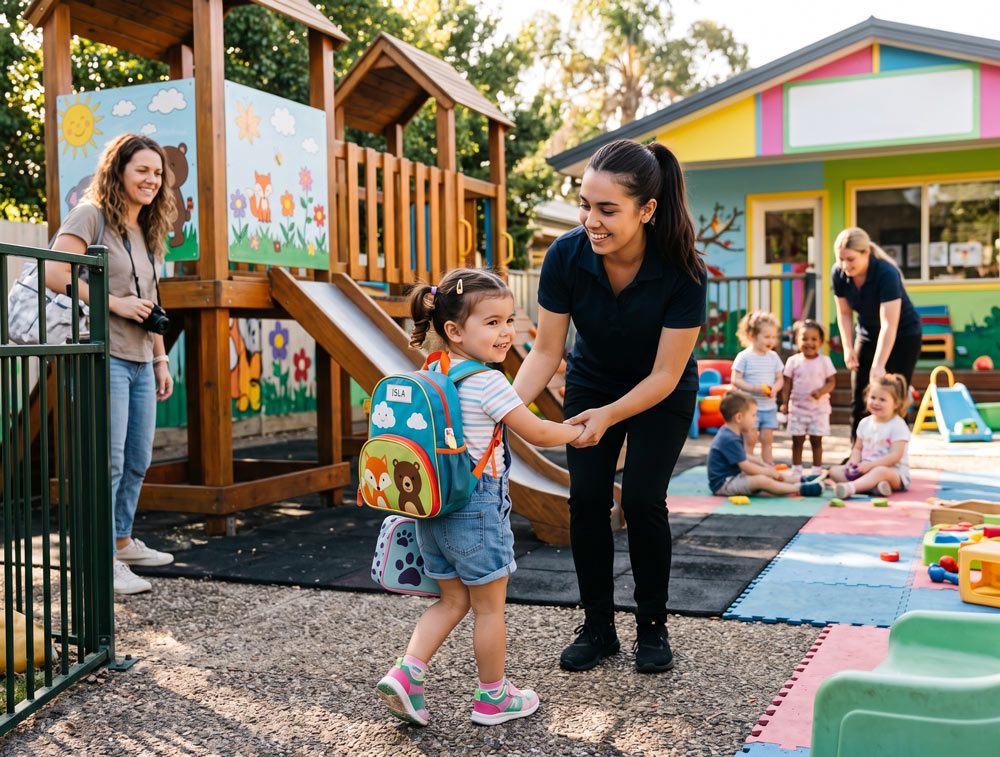
This is the big one. Create a small goodbye ritual and repeat it every single day. A hug, a kiss on each cheek, a phrase like I love you, have fun, I will be back after snack. Then hand your child to the teacher and leave. Do not sneak out while they are distracted, because finding out you vanished breaks trust and makes tomorrow worse. And do not linger, because a long goodbye tells your child there is something worth worrying about. Short does not mean cold. It means confident.
Pack a Piece of Home
A small comfort object works wonders for many children. A family photo taped inside the cubby, a tiny blanket, a shirt that smells like you. Ask the teachers what they allow. Something familiar to hold during the first few naps can be the bridge between home and this new place.
Name the Feelings, Then Point to the Plan
With toddlers and preschoolers, simple honest language beats elaborate reassurance. You feel sad when I leave. That is okay. Miss Emma will take care of you, and I always come back. The phrase I always come back is worth repeating daily. Young children live in the present, and the predictability of your return is the anchor they hold onto.
Understanding Separation Anxiety, and Why It Is Actually Healthy
Here is a reframe that helps a lot of parents. Daycare separation anxiety is not a sign something is wrong. It is a sign your child is securely attached to you, which is exactly what you want. A child who protests your leaving is a child who knows who their safe people are. That attachment is the foundation they will stand on while learning to trust new caregivers.
Separation anxiety typically peaks between about eight and eighteen months, then comes and goes in waves through the preschool years. It often spikes after holidays, illnesses, or any break in routine. So if your child sails through week one and then falls apart in week three, nothing is broken. That is a completely normal pattern that teachers see every single year.
What helps most is consistency between home and school. Good programs treat the transition as a partnership. When you tour a childcare development center, ask how they handle the first weeks for new children. Listen for words like gradual, routine, and communication. Programs that send photos or quick updates during the day take a huge weight off parents, because the picture of your child laughing at the sensory table at 10 a.m. does more for your nerves than any pep talk.
Our son screamed at drop off for the first four days and I was ready to quit my job, honestly. His teacher told me he stopped within two minutes of me leaving every time, and she started sending me a photo each morning to prove it. By the second week he was waving me off. Now he runs in without looking back and I am the one standing there feeling slightly rejected.
Priya S., mom of a two year old, Easton
The First Two Weeks: What to Expect
A realistic picture beats a rosy one, so here is what the settling period usually looks like.
- Days one to three: Tears at drop off are common, and they typically stop within minutes. Your child may be clingy and tired at home in the evenings. Extra cuddles and early bedtimes help.
- Days four to seven: Most children start engaging with toys, teachers, and other kids, even if drop off is still wobbly. Appetite and naps at the center begin to normalize.
- Week two: Many children develop a favorite teacher, a favorite activity, or a small friend. Drop offs shorten. Some children regress briefly right when you think you are through it. Also normal.
- Weeks three and four: The routine clicks for most kids. Mornings become ordinary, which is the quiet victory nobody celebrates enough.
A few practical notes for this stretch. Expect your child to catch a cold or two as their immune system meets a new environment. Build a little slack into your work schedule for the first month if you possibly can. And label everything you send in, because sixteen toddlers own the same water bottle.
When to Check In With the Teachers
Most rough patches smooth out on their own, but keep the communication line open. If crying lasts most of the day rather than minutes, if your child stops eating or sleeping at the center after a few weeks, or if your gut simply says something is off, ask for a conversation. Good teachers welcome it. A quality childcare near Phillipsburg will describe your child’s day in specifics, not generalities, and will work with you on a plan rather than brushing off your concerns.
It is also worth knowing what surrounds you locally. Families in the Phillipsburg area have a strong early learning community, from private centers to public programs like the Phillipsburg Early Childhood Learning Center, and statewide resources on New Jersey’s early childhood programs outline what quality early education looks like. The more familiar you are with what good care involves, the more confident you will feel about the choice you made.
One last thing, parent to parent. The day will come, probably sooner than you expect, when your child runs into that classroom without a backward glance. It will sting a little. It is also the whole point. A child who separates easily is a child who has learned the world is safe and you always come back. That lesson started with you, on a nervous morning in a parking lot, doing the brave thing.
Take Care of Yourself Too
This part gets left out of most guides, so let us put it in writing. Plan something for yourself on the first morning. Not a big thing. Coffee with a friend, a walk, an errand you actually enjoy. Sitting in your car in the parking lot refreshing the parent app helps nobody, least of all you. If you work, tell a colleague it is your child’s first day so someone checks in on you around lunchtime. Parents need soft landings too.
And go easy on the comparisons. Your coworker’s daughter who skipped into daycare on day one without a single tear is not the standard. Neither is your cousin’s son who cried for a month. Children are wired differently, and the same child can handle two transitions in completely different ways a year apart. The only timeline that matters is your child’s own progress from week to week. If the trend is pointing in the right direction, even slowly, you are doing this right. Preparing your toddler for daycare is really about preparing the whole family, and that includes the grown ups who love them most.
Frequently Asked Questions
How long does daycare separation anxiety usually last?
For most children, the intense phase lasts one to three weeks, with occasional flare ups after breaks or illness. Consistent drop off routines shorten it considerably. If distress lasts most of the day beyond a month, talk with the teachers about a gradual plan.
Should I stay at daycare with my child on the first day?
A brief settling visit before the official start helps, but on the actual first day, a short confident goodbye works better than lingering. Staying too long usually prolongs the tears. Follow the program’s guidance, since teachers manage this transition constantly.
What should I pack for the first day of daycare?
Typically two full changes of labeled clothing, diapers and wipes if needed, a nap item like a small blanket, any bottles or lunch the program requires, and a comfort object if allowed. Label every single item, including shoes and water bottles.
Is it normal for my child to cry at drop off but be fine all day?
Extremely normal, and one of the most common things teachers reassure parents about. The transition moment is hard, not the day itself. Ask for a photo or midmorning update during the first week if it helps your peace of mind.
How can I build a good daycare drop off routine?
Keep it identical every day. Same order of events, same short goodbye ritual, same parting phrase, then a clean exit. Predictability is what tells a young child everything is safe. Add a consistent pickup phrase too, like I came back, just like I promised.